What Does 'Olé' Really Mean in Spanish? the Hidden History Behind the World's Most Famous Cry
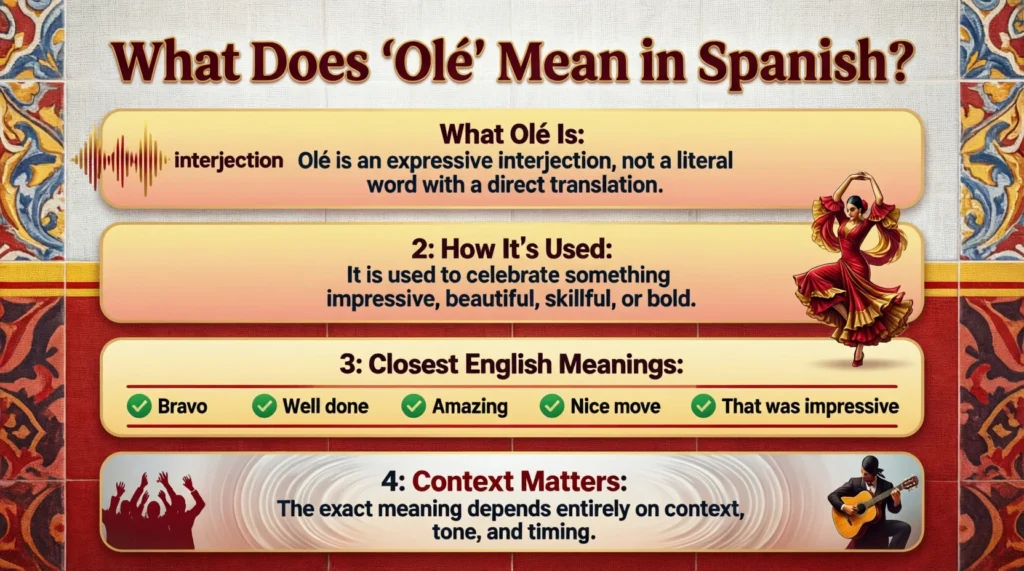
Nowhere is the word more deeply embedded than in flamenco. The art form was built on duende, the mysterious, ineffable power that poet Federico García Lorca described as an interior fire, an unteachable struggle between performer and mortality.
When a flamenco singer (cantaor) hits a pitch of raw emotional devastation, or a dancer (bailaora) lands a percussive, syncopated rhythm on the wooden boards, the audience does not respond with polite clapping. They cry out ¡Olé! It acts as an acknowledgment that the artist has touched something transcendent. Shouting it at the wrong moment, however, exposes an amateur. Flamenco aficionados consider ill-timed exclamations a violation of the performance's rhythm and soul.
Parallel to the musical stage, the bullring (plaza de toros) cemented the word's cadence across broader Spain. When a matador stands motionless while a half-ton bull rushes past within inches of their torso, the entire amphitheater releases its collective breath in a synchronized, guttural ¡Olé! Each successive pass of the scarlet cape demands another shout, establishing a rhythmic dialogue between danger and spectator.
| Context & Domain | Primary Cultural Meaning | Typical Vocalization & Cadence |
|---|---|---|
| Andalusian Flamenco | Recognition of duende, vocal mastery, or rhythmic transcendence | Spontaneous, sharp, throat-centered; yelled at peak musical tension |
| Traditional Bullfighting | Tension release during successful, death-defying cape passes | Drawn-out unison roar (*¡Ooooo-lé!*) paced precisely to each charge |
| Club & International Soccer | Crowd mockery celebrating stringed possession passes against rivals | Short, rhythmic bark on every completed ball transfer |
| Global Arena Anthems | Communal victory celebration, team unity, and party euphoria | Melodic, repetitive chorus (*Olé, Olé, Olé, Olé... Champ-ions!*) |

